These interfaces are governed independently within each function and contract, without a unifying mechanism capable of maintaining alignment across them.
As a result, accountability remains centralised with the owner, while control over how cost develops is distributed across multiple functions and delivery environments. Visibility is therefore fragmented, and alignment is not actively maintained across the system.
Cost exposure as a governance condition
Cost exposure develops progressively within systems that continue to perform. As execution advances across multiple projects, measured work is converted into certified value, and the overall cost position evolves accordingly.
This evolution becomes visible through outcomes. Budget positions adjust, forecasts respond and commercial positions shift across the portfolio.
Cost is therefore not simply incurred. It is formed through the interaction between measurement, valuation and certification across the system.
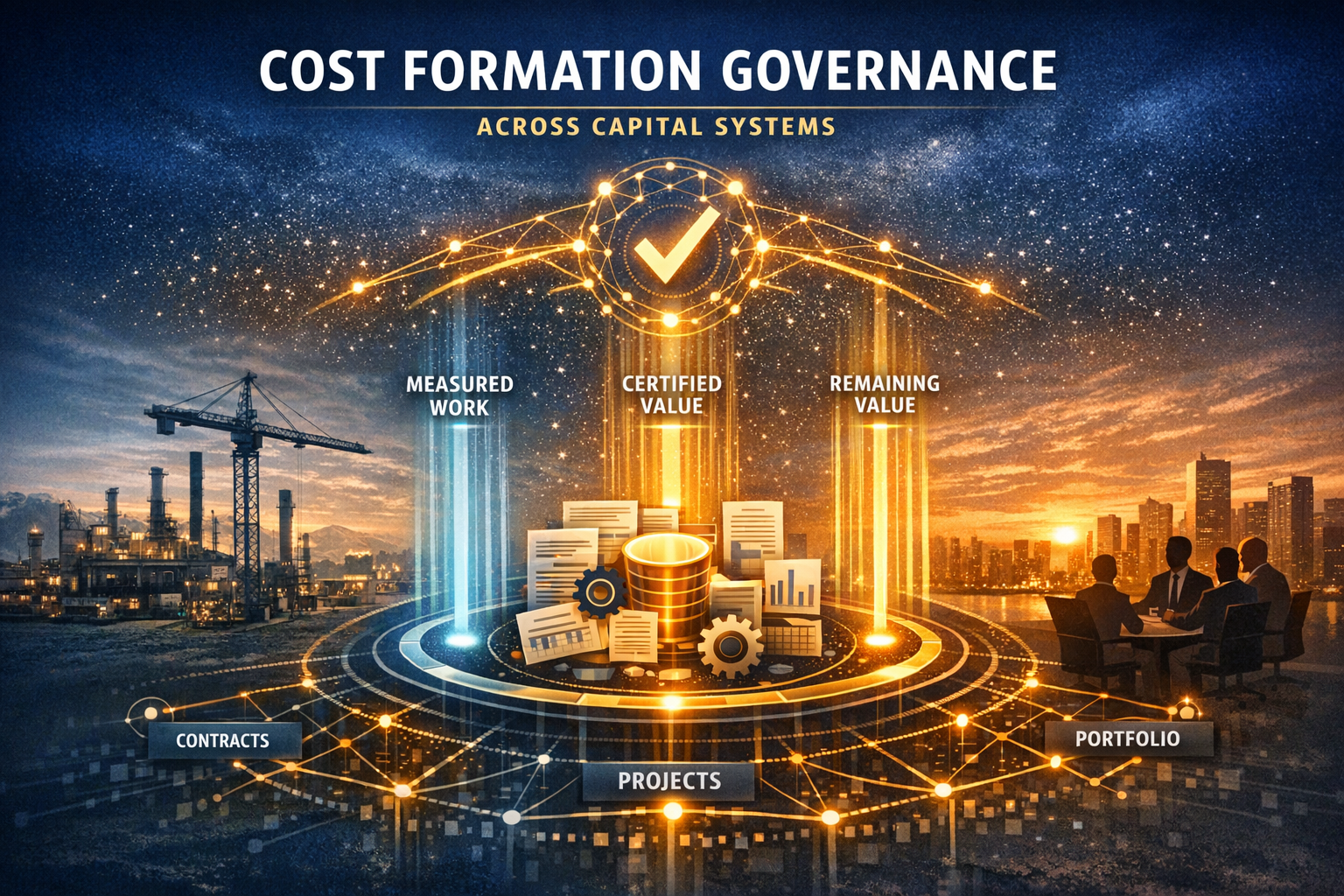
Within this interaction, measured quantities, certified value to date and the remaining value across contracts together describe how the cost position is developing relative to its approved basis. Where this relationship is not actively maintained, the connection between execution and the approved position becomes less certain over time.
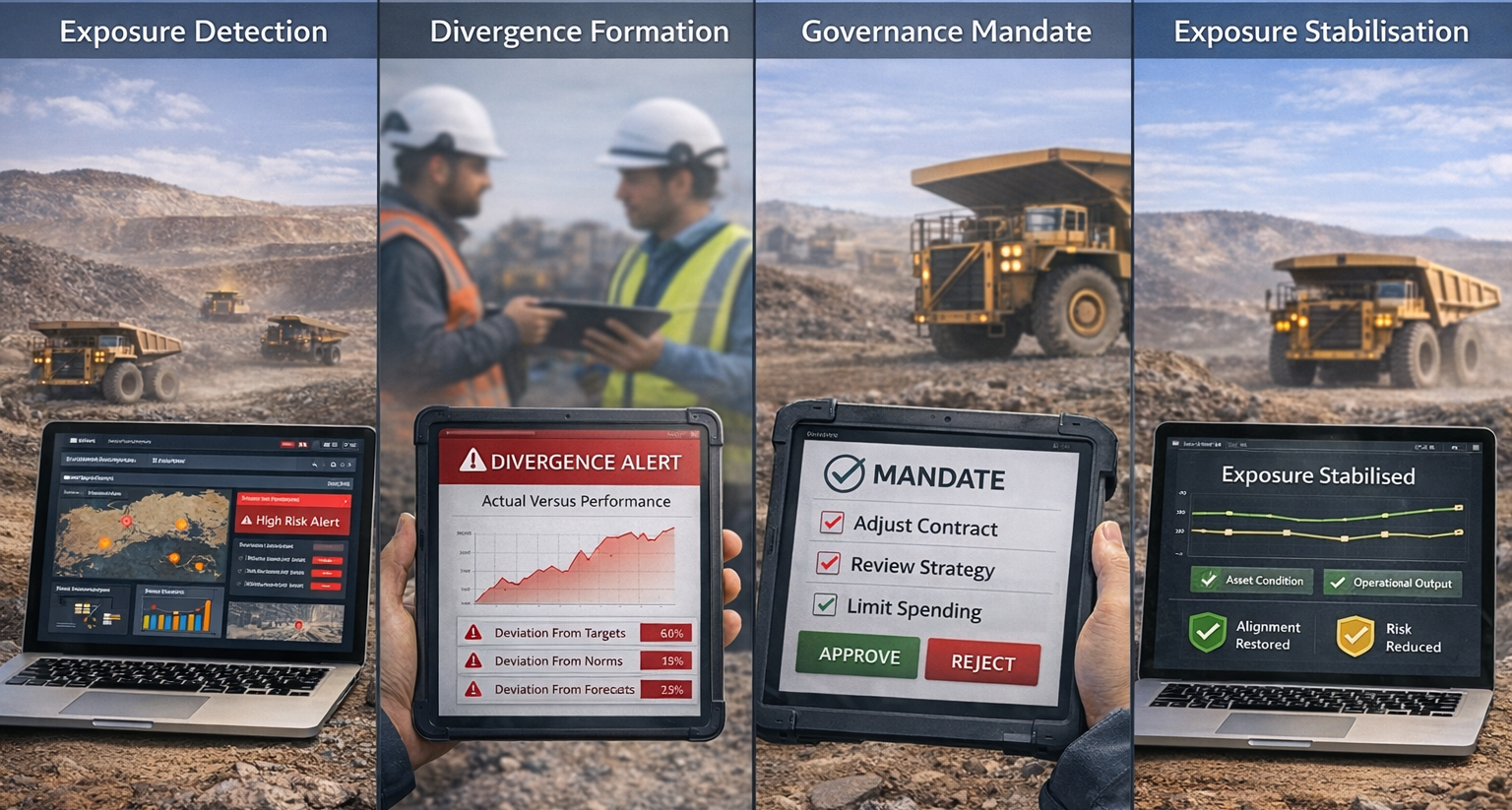
As this occurs across multiple contractors and contracts, divergence forms within the system rather than at any single point of control.
By the time variance is visible in reporting, it reflects cost that has already been established through certification across the system.
Why cost alignment sits outside formal governance
Conventional governance frameworks provide assurance across financial performance, risk, compliance and reporting.
These structures are effective within their domains.
However, they do not govern how cost is formed during execution. The processes through which work is measured, valued and certified operate within delivery and commercial interfaces rather than within formal governance structures.
Cost alignment therefore exists across the interaction between scope definition, physical execution and commercial entitlement. It is not owned by any single function and is often assumed to be maintained through existing processes.
No single function or contract has the authority to maintain alignment across these interactions as they develop.
This creates a gap in governance, not in capability.
Cost formation as a defined governance requirement
Maintaining capital cost integrity requires governance to operate where cost is created, across the interaction between measured work, applied value and certified entitlement.
This interaction must remain aligned to the approved commercial structures under which the capital portfolio was sanctioned. Where changes to scope occur, approved variations form part of that position.
Measured work, certified value and remaining value must therefore be continuously reconciled to the approved position across all contracts as execution progresses. This relationship defines whether cost remains aligned or is moving away from its original basis.
Maintaining this reconciliation across contracts requires consistent application of measurement, valuation and certification that cannot be achieved within isolated delivery or commercial functions.
Governance operates by maintaining this alignment, ensuring that the approved capital position remains the reference point across projects, and that this consistency is sustained across measurement, commercial and contractual interfaces under owner authority.
A governance blueprint for cost formation across capital systems
A governance blueprint establishes how control is exercised at the point where cost is formed.
It provides visibility across the relationship between measured work, certified value and remaining value across contracts, enabling the cost position of the portfolio to be understood in direct relation to its approved basis.
Through this structure, cost is continuously reconciled across projects. Changes in measured work and certified value within individual contracts are reflected in the overall remaining value, allowing the capital position to be understood as it develops.
This requires alignment to be maintained across contractors and contractual positions simultaneously, rather than within individual project or contract boundaries.
Governance operates by maintaining this relationship across organisational, contractual and operational interfaces. It does not direct execution, but ensures that the processes through which cost is created remain aligned across the system.
This provides consistency across contractors and delivery environments, while preserving the integrity of capital outcomes.
From application to governance standard
When applied consistently, this approach becomes structured and repeatable. The conditions for maintaining alignment, the decision pathways through which it is governed and the mechanisms for reconciliation can be clearly defined.
This enables the approach to be formalised as an owner-level governance policy, embedding the capability to maintain cost alignment across the capital system under defined authority.
Restoring alignment between accountability and control
Where cost formation is governed at system level, the relationship between accountability and control is strengthened.
Boards and executives gain visibility of how cost is being created across the portfolio, including how certified value and remaining value relate to the approved capital position.
This allows the cost trajectory to be understood as it develops, supporting timely and informed decision-making across the investment system.
A closing perspective
Projects can maintain delivery performance while cost exposure develops within them.
Where cost formation is not governed as a unified system, cost develops progressively across projects and becomes visible only once embedded within outcomes.
Where this interaction is governed, alignment is maintained across the capital system, and visibility is established at the point where cost is created.
External pressures do not determine cost outcomes; they expose whether alignment has been maintained within the system where cost is formed.
Cost Formation Governance Across Capital Systems is one of several defined governance conditions
Access Governance Policy Register