Capital assurance

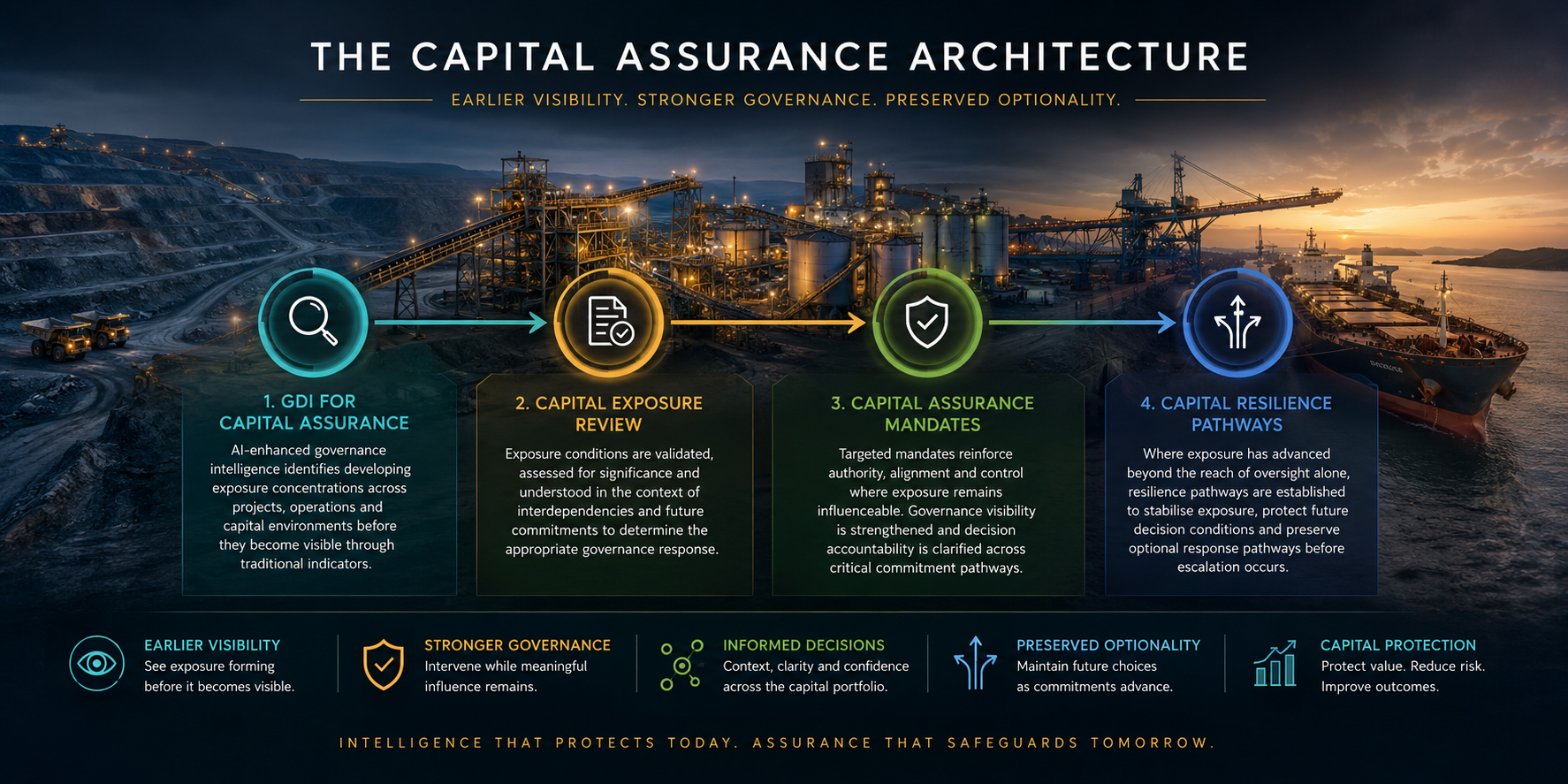
Capital exposure rarely becomes visible when it first develops. More often, it forms quietly within commitments, assumptions and decision pathways long before it appears through cost, schedule or operational performance indicators. This article explores how GDI for Capital Assurance identified developing exposure concentrations across a large resource portfolio, how those conditions progressed through Capital Exposure Reviews and Capital Assurance Mandates, and why selected exposures ultimately required Capital Resilience Pathways to preserve future decision flexibility before commitments became materially harder to influence.


Strong enterprises do not lose market support suddenly. More often, enterprise exposure develops progressively as governance visibility, stakeholder alignment and strategic positioning fail to mature at the same pace as capital expectations. In increasingly complex funding and development environments, technical capability alone no longer sustains long-term credibility. Enterprise maturity, governance discipline and positioning consistency are now becoming equally important in maintaining stakeholder conviction and protecting enterprise value through growth and capital progression.

Most projects rely on turnaround and optimisation once outcomes are visible. By that point, positions are already embedded and difficult to change. Governance operates earlier - where decisions are made, and commitments are formed - when alignment can still be achieved with minimal disruption and at significantly lower cost. The difference is not capability, but when intervention occurs, and what it costs to act at that point.

Most capital projects exceed budget not because controls are absent, but because exposure forms before it is visible. As decisions are made under pressure and commitments begin to lock in, assumptions are carried forward without being fully tested. This article examines why structured project controls and traditional assurance do not fully capture this early-stage exposure - and why governance must be applied at the point where capital decisions are made, not where outcomes are reported.

Where confidence in reporting, decisions or control begins to reduce, and decisions are progressing under increasing pressure, a Capital Exposure Review provides independent visibility of where exposure is forming within current positions. It establishes clarity before commitment, ensuring that emerging risks are understood while options remain open and before positions become constrained or irreversible.

Market demand often accelerates ahead of operational capacity, creating pressure to commit before systems are ready. This case shows how exposure forms across the transition - from offshore completion and delivery through to installation, commissioning and ramp-up - and how it can destabilise performance if unmanaged. Through TacminMadini’s governance architecture, exposure was detected early, decisions were assured, and the system stabilised, enabling new capacity to convert into real output. Detect early. Assure decisions. Stabilise outcomes. TacminMadini Governance Architecture