The question therefore becomes:
Does the enterprise that exists today possess the capability, governance maturity and organisational readiness required to support the enterprise being contemplated?
A growth-stage mining company may currently operate as follows:
A technically attractive opportunity alone does not guarantee a successful investment outcome.
More often, investment outcomes deteriorate because the enterprise itself struggles to evolve as growth accelerates.
- Governance fails to mature.
- Capability fails to scale.
- Stakeholder complexity increases.
- Decision-making becomes increasingly strained.
- Capital is introduced into an enterprise that has not yet evolved to absorb it.
As a result, investment risk frequently resides not only within the project, but within the enterprise itself.
This is where many growth initiatives stall.
How does an organisation transition from the enterprise that exists today to the enterprise required tomorrow?
Enterprise Readiness Through Governance Decision Intelligence (GDI)
TacminMadini applies Governance Decision Intelligence (GDI) to independently assess:
- the enterprise that exists today;
- the enterprise implied by future ambitions;
- the conditions required to bridge that gap; and
- the pathway through which capability, governance and organisational maturity should progressively evolve.
Importantly, Enterprise Readiness recognises that organisational capability, governance maturity and enterprise structures should evolve progressively alongside growth, funding and development milestones.
Enterprise Readiness does not assume that all capabilities must exist immediately.
Rather, it establishes:
- What capability is required?
- When is it required?
- Under what conditions should it be introduced?
This enables:
- enterprise evolution to occur progressively;
- investment pathways to be staged appropriately;
- governance maturity to evolve with complexity;
- future commitments to accelerate with greater confidence; and
- capital to be introduced into an enterprise capable of absorbing growth sustainably.
Through GDI, TacminMadini identifies:
- capability gaps;
- governance requirements;
- scalability constraints;
- sequencing priorities;
- growth pathway dependencies;
- investment readiness conditions; and
- enterprise evolution requirements.
The objective is not simply to assess readiness.
The objective is to strengthen enterprise confidence before growth complexity becomes materially harder to influence.
For growth-stage enterprises, Enterprise Readiness strengthens confidence that future ambitions remain achievable.
For investors, it strengthens confidence that the enterprise receiving capital can absorb growth sustainably.
Because successful investment depends not only on the quality of the opportunity, but on the readiness of the enterprise expected to deliver it.
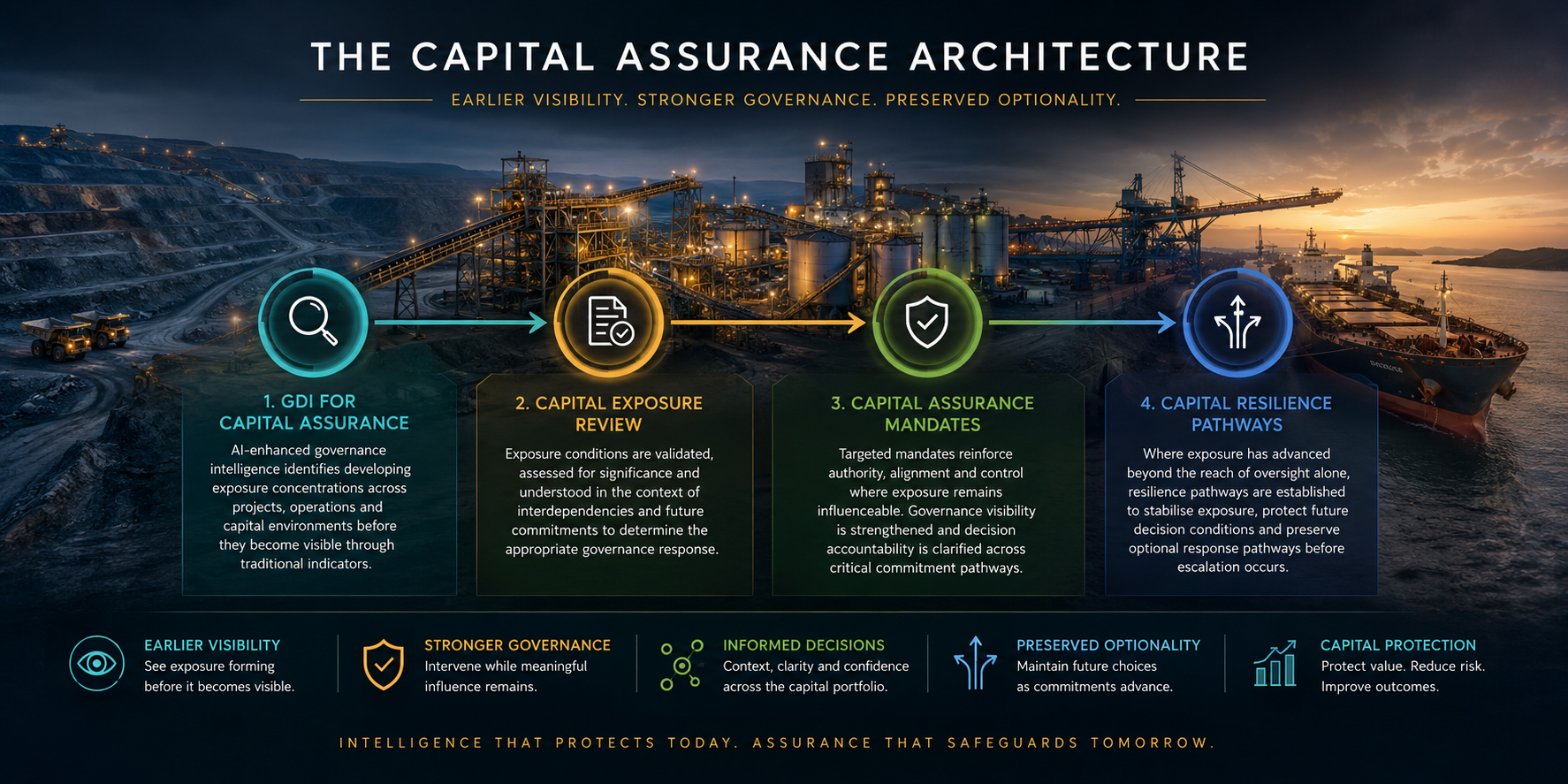
As investment pathways advance and commitments begin to accelerate, attention increasingly shifts from enterprise evolution to capital protection, governance visibility and decision defensibility.
This is where Capital Assurance becomes increasingly important.