The Risk Environment Has Changed
Over the past decade, organisations have operated through an extended period characterised by geopolitical instability, logistics disruption, inflationary pressures, trade tensions and supplier instability.
Recent Deloitte research found that more than 70% of procurement leaders reported increased procurement-related risk and supply disruption, while 43% indicated that overall procurement risk had increased significantly compared with only 20% two years earlier. Importantly, many leaders no longer regard disruption as temporary. Increasingly, supply volatility is being treated as a permanent operating condition rather than an exceptional event.
At the same time, procurement leadership is moving closer to executive decision-making as organisations recognise the growing influence of supply capability on enterprise resilience, commercial performance and long-term value creation.
For capital-intensive industries, these developments carry significant implications.
Mining's Growing Exposure
Mining and infrastructure projects depend upon increasingly complex ecosystems involving OEMs, manufacturers, contractors, logistics providers, specialist service organisations and multiple commercial interfaces.
As projects become larger, geographically dispersed and increasingly international, disruption within any part of the supply environment can influence:
- Capital commitments
- Project schedules
- Commercial performance
- Operational continuity
- Stakeholder confidence
- Investment outcomes
Recent EY research identified operational complexity as the leading business risk facing the mining and metals sector. The report highlights an increasing shift away from purely external risks towards operational challenges that directly influence productivity, cost performance and delivery outcomes.
The transition towards critical minerals, increasing localisation requirements, geopolitical fragmentation and growing competition for strategic resources has further increased supply complexity across the mining sector. As organisations seek to secure reliable access to critical equipment, materials and specialist capability, supply chain resilience is becoming increasingly important to long-term competitiveness and growth.
While disruption itself remains significant, the more fundamental challenge for many organisations is limited visibility across increasingly complex supply environments.
The Visibility Gap
Most organisations maintain detailed information relating to purchase orders, delivery schedules and supplier performance.
Far fewer possess sufficient visibility into the broader exposure created by their supply environments.
Questions frequently remain inadequately addressed:
- Which suppliers represent critical single points of failure?
- Where do the most significant supply vulnerabilities exist?
- Which disruptions could materially affect capital outcomes?
- How resilient are current sourcing arrangements?
- What alternative supply pathways are available?
- How rapidly could emerging exposure be identified, escalated and addressed?
Without this visibility, organisations frequently discover supply-related exposure only after project, operational or commercial performance has already been affected. By this stage, available response options are often constrained and recovery costs significantly increased.
Governance Begins Before Disruption Occurs
Operational procurement activities remain management responsibilities. However, governance structures remain accountable for understanding material exposure capable of influencing enterprise, capital and operational outcomes.
As supply environments become increasingly complex, effective governance requires earlier visibility, clearer accountability and greater confidence in the information supporting critical decisions.
Reliable procurement outcomes rarely begin with transactions alone. They are typically preceded by:
- Strategic clarity
- Defined accountability
- Appropriate supplier selection
- Commercial alignment
- Exposure visibility
- Structured decision-making
These foundations influence not only procurement performance but also broader enterprise confidence.
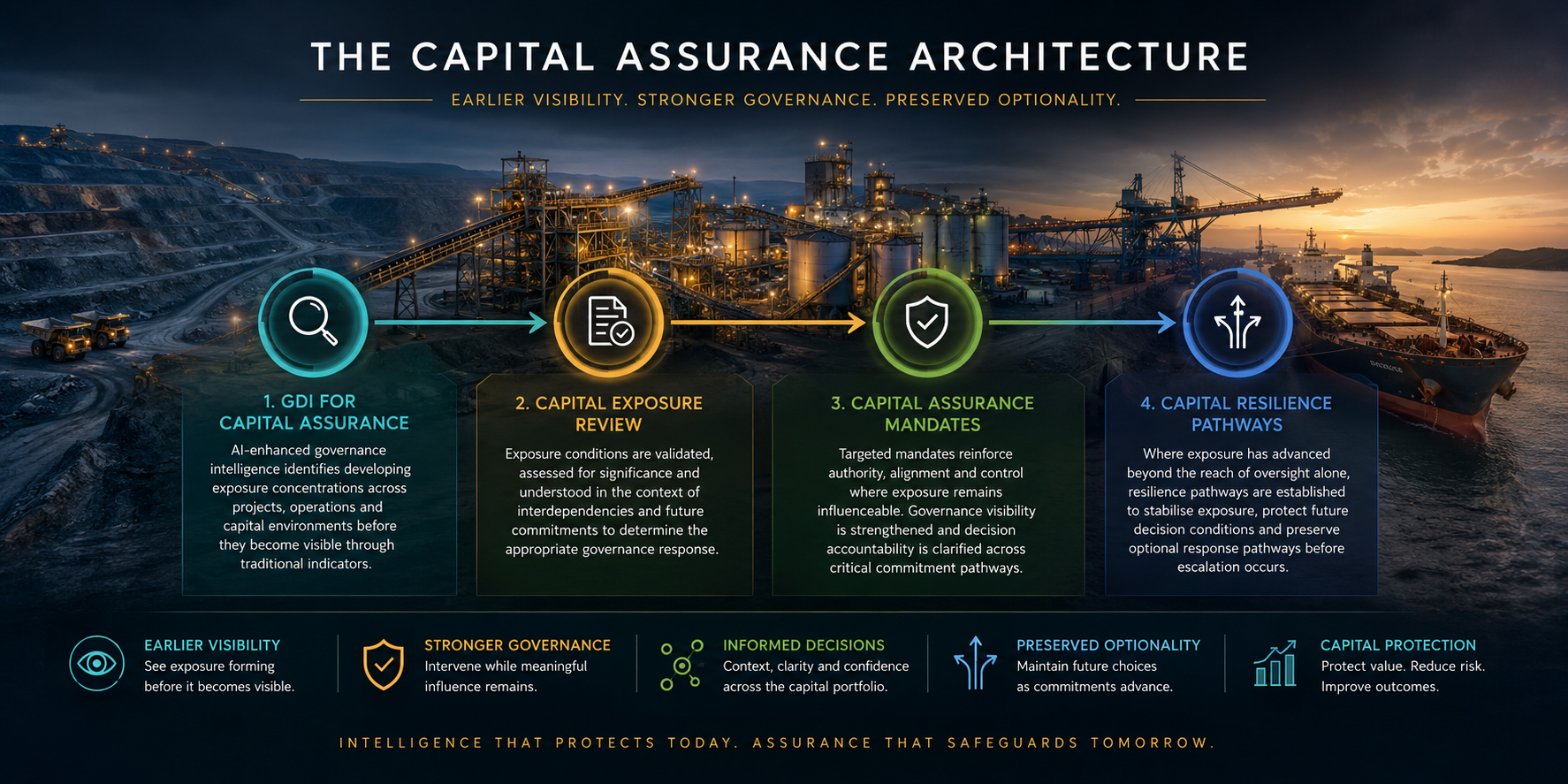
Supply-related exposure increasingly influences Enterprise Readiness, Capital Assurance and Capital Control across the capital lifecycle.
Questions Organisations Should Be Asking
As supply environments become increasingly material to enterprise outcomes, organisations should consider whether they possess sufficient visibility to answer several fundamental questions:
- Where are our critical supply vulnerabilities?
- Which suppliers represent single points of failure?
- How resilient are our sourcing strategies?
- What supply disruptions could materially affect capital outcomes?
- How quickly would emerging exposure be escalated?
- Do existing reporting structures provide sufficient visibility into supply-related risk?
The objective is not to manage procurement directly, but to ensure that decision-makers possess sufficient visibility to exercise effective governance.
From Procurement Execution to Supply Governance
Organisations most likely to protect value in uncertain environments will not necessarily be those that procure most efficiently. They will be those that identify exposure earliest, understand the implications clearly and respond before disruption materially influences outcomes.
As supply environments become increasingly complex, organisations require earlier visibility into emerging exposure, stronger governance across supply ecosystems and greater confidence in the information supporting critical decisions.
Protecting value across the capital lifecycle increasingly depends upon the ability to anticipate, understand and respond to supply-related exposure before it materially influences enterprise, capital or operational outcomes.
In this environment, supply chain oversight can no longer remain solely an operational discipline. It has become an essential component of enterprise governance.