Looking Beyond Traditional Indicators
What made the findings particularly relevant was that none of the identified conditions were visible through traditional performance indicators. No material cost overruns had emerged. No major delivery failures had occurred. Operational performance remained largely stable.
However, GDI identified exposure concentrations developing around several procurement pathways, execution assumptions and operational transition activities. In one operating environment, procurement commitments were advancing ahead of the certainty supporting future execution requirements. In another, operational transition assumptions were beginning to diverge from emerging implementation realities.
Individually, these conditions appeared manageable. Collectively, they represented a growing concentration of exposure capable of influencing future capital outcomes across multiple operating environments.
More importantly, exposure was advancing faster than governance visibility. While commitments continued hardening, visibility of the implications of those commitments was not advancing at the same rate. This is often where exposure becomes progressively embedded, not when performance deteriorates, but while conditions continue appearing acceptable.
Making Exposure Visible
Identification alone does not determine whether exposure requires intervention.
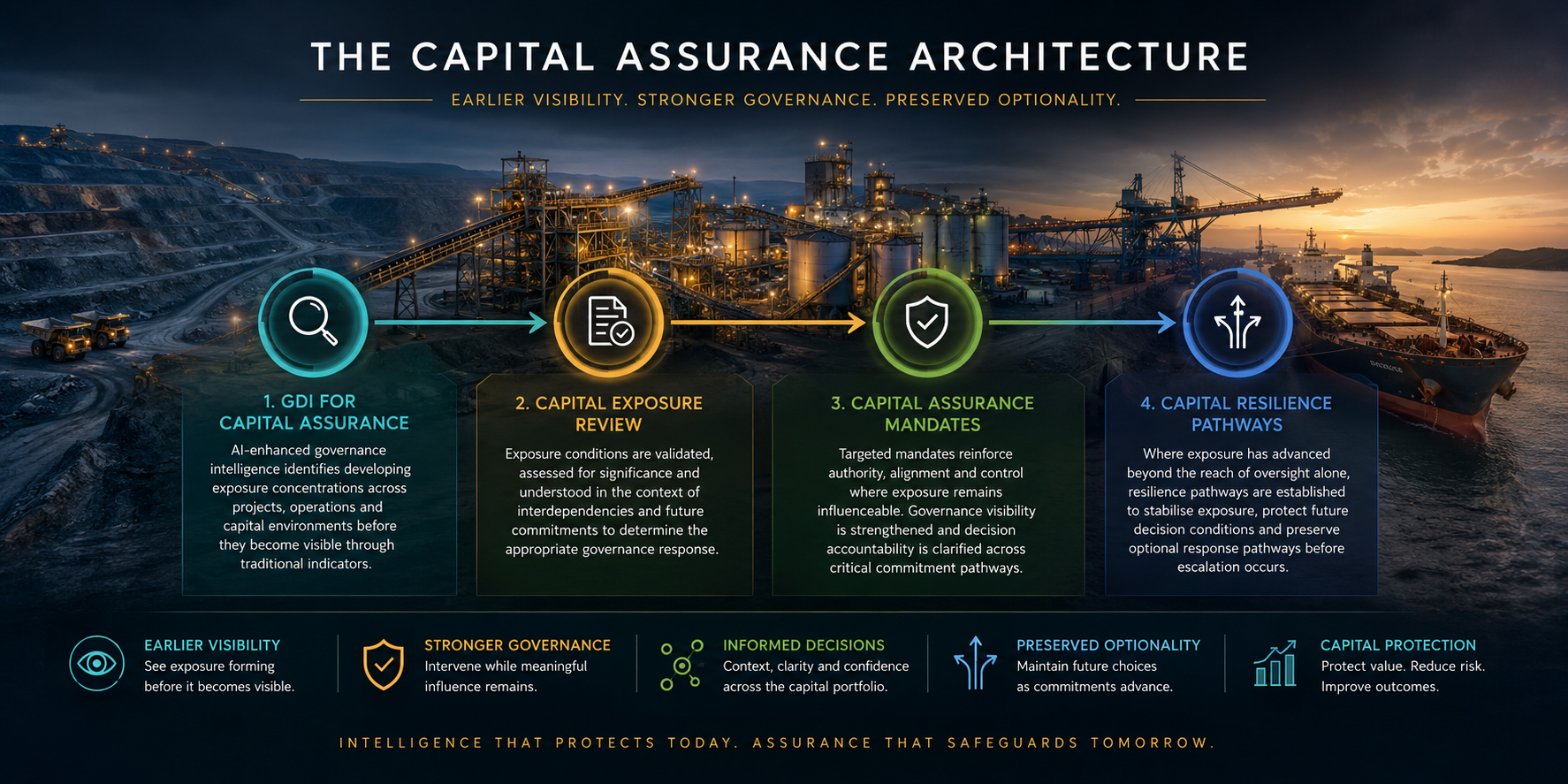
Following detection through GDI, the exposure concentrations were subjected to a Capital Exposure Review to validate the conditions, assess their significance and understand how they were developing across the broader operating environment.
The review confirmed that several concentrations warranted governance intervention. It also revealed that exposure was not isolated to individual projects or operating areas. Certain conditions were influencing multiple commitments simultaneously, increasing their potential to affect future capital outcomes if left unaddressed.
This stage transformed developing observations into visible exposure conditions capable of supporting informed governance decisions.
Built Through Delivery
The exposure concentrations identified through the engagement were not unusual. Similar patterns have emerged repeatedly across major projects, operating mines, infrastructure developments and capital-intensive environments over many years.
This is reflected in how GDI was developed.
Built through more than three decades of project delivery, turnaround and operational improvement experience, GDI combines governance intelligence, exposure analytics and AI-assisted pattern recognition to identify recurring exposure conditions before they become visible through conventional reporting structures.
The value is not simply in identifying anomalies within data. The value lies in recognising the significance of developing conditions based on how similar exposure patterns have historically influenced future outcomes as commitments advance.
Reinforcing Authority, Alignment And Control
Following completion of the Capital Exposure Review, Capital Assurance Mandates were established across several priority areas.
The purpose of the mandates was not to direct project execution. Responsibility for delivery remained with operational leadership, project teams and appointed delivery partners. Instead, the mandates focused on reinforcing authority, alignment and control where governance visibility required strengthening.
Additional oversight mechanisms were introduced. Escalation pathways were clarified. Decision accountability was strengthened around commitment pathways where exposure had become increasingly concentrated.
As a result, owners and governance bodies gained clearer visibility of how exposure was developing and where future capital outcomes could become increasingly influenced by conditions not yet reflected in operational performance.
In several areas, strengthened visibility and improved governance alignment proved sufficient to stabilise emerging exposure conditions before they became more deeply embedded.
When Oversight Alone Is No Longer Enough
As the engagement progressed, it became evident that not all exposure concentrations required the same response.
Several identified conditions responded positively to increased visibility, strengthened oversight and improved governance alignment. In these areas, exposure intelligence and targeted intervention improved decision confidence and reduced uncertainty around future commitments.
However, two exposure concentrations proved materially different.
In both cases, exposure had advanced sufficiently within existing commitments that improved visibility alone was unlikely to fully stabilise future decision conditions. Governance awareness improved. Decision confidence strengthened. Yet the underlying exposure remained linked to commitments that had already become partially embedded within future pathways.
At this point the challenge was no longer visibility. The challenge became preserving future optionality.
Transitioning Into Capital Resilience Pathways
Those exposure concentrations have now progressed into Capital Resilience Pathways.
The focus has shifted from strengthening visibility towards stabilising exposure and protecting future decision conditions before escalation occurs. Alternative response pathways are being evaluated. Contingency positions are being strengthened. Future intervention triggers are being established and potential stabilisation options are being assessed should conditions evolve beyond current assumptions.
The objective is not to predict adverse outcomes.
The objective is to ensure that viable decision pathways remain available before future options become constrained by commitments that have already advanced beyond direct influence.
This distinction is important. Capital Assurance Mandates reinforce authority, alignment and control. Capital Resilience Pathways stabilise exposure and decision conditions where oversight alone is no longer sufficient.
Why Earlier Visibility Matters
The distinction between conventional capital oversight and the Capital Assurance Architecture is not one of governance quality. Both seek to protect value and improve decision-making.
The difference lies in timing.
Conventional oversight generally responds once exposure becomes visible through performance indicators. The Capital Assurance Architecture seeks to identify where exposure is forming before those indicators begin reflecting the consequences.