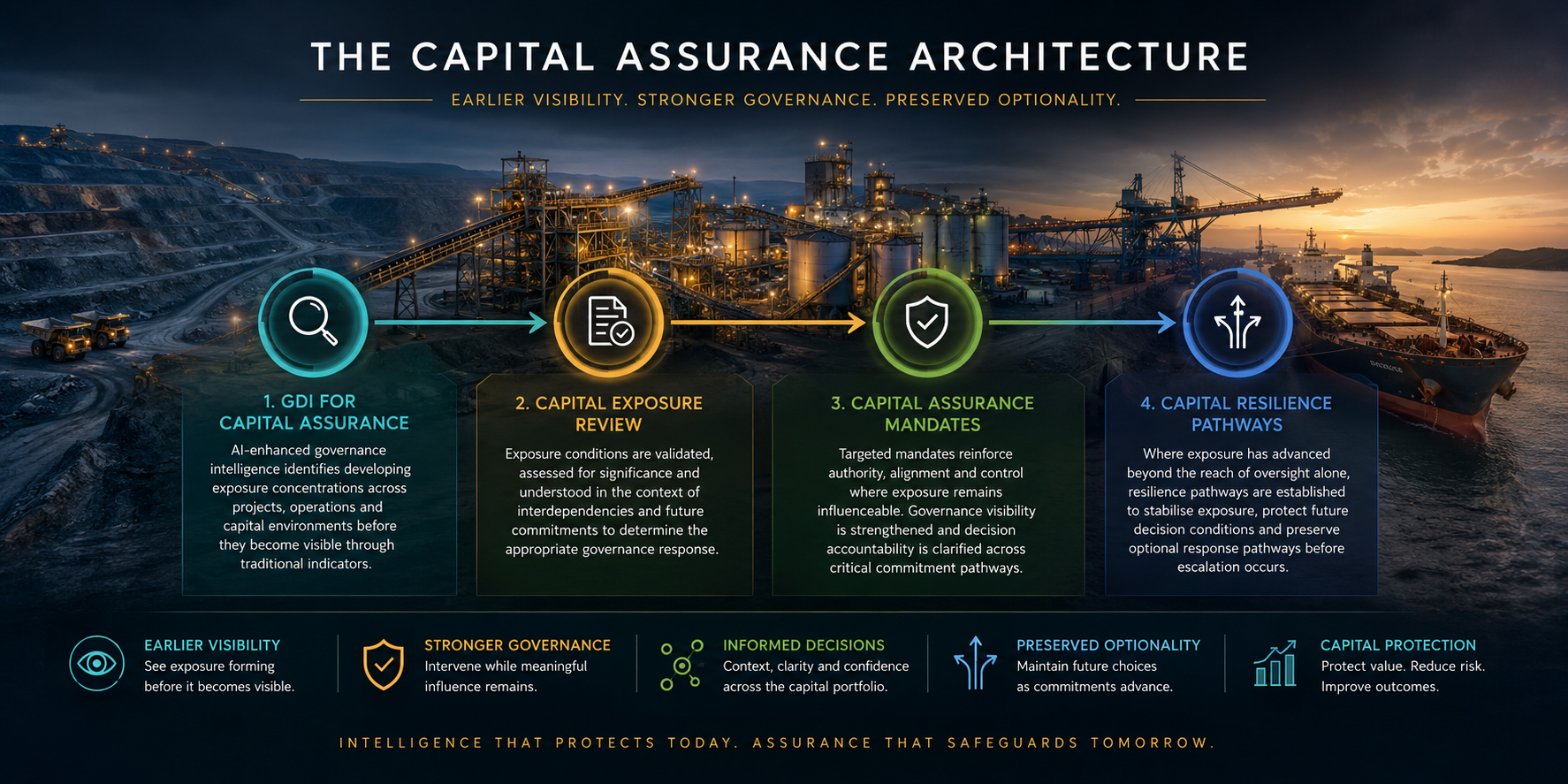
Preventing capital loss before turnaround and optimisation become necessary

Cost overruns are visible after they develop

Across mining, infrastructure and housing delivery, cost overruns and delays are typically identified after they have already taken shape. They emerge through revised forecasts, contractor claims, or schedule slippage.


By that stage, contracts are in place, scope has been defined, and delivery structures are operating. The position is already embedded. The ability to materially change it is reduced, even though accountability remains with the owner.


Decisions progress while information continues to evolve

Projects do not wait for complete information. Scope definition, procurement, contractor engagement and commercial commitments are progressed in parallel.


Decisions are made based on the information available at that point, while that information continues to evolve as the project advances. The position assumed at the time of decision is not always the position that ultimately emerges.

Delivery is fragmented across multiple parties

Delivery is distributed across contractors, subcontractors and suppliers, each operating within defined scopes and commercial arrangements. No single party is responsible for the full integration of scope, cost, schedule and commercial position.


Interfaces are managed, but not always fully aligned. Misalignment between scope definition, contractual structure and execution develops progressively and is often only visible once it has already affected cost and delivery.


Visibility follows exposure, not the other way around

Reporting provides visibility of cost, schedule and performance as they develop. It reflects what has occurred or what can be forecast with sufficient confidence.


It does not fully capture how the current position has been created across multiple decisions and commitments. By the time exposure is visible, it has already been carried forward.


Turnaround and optimisation work within the position

Turnaround is applied when performance deteriorates. It stabilises delivery and attempts to recover cost and schedule under constraint.


Operational improvement strengthens efficiency within systems that are already established.


Both operate on the position as it exists. Their effectiveness depends on how much of that position can still be influenced.


Avoiding recovery as the default outcome

Once commitments are fixed within contracts and delivery systems, the ability to change them is limited. From that point, turnaround and optimisation become the primary mechanisms available.


They operate under constraint. They manage cost, delay and performance within a position that has already been established.


Relying on turnaround and optimisation means the position has already been carried forward. In many cases, that point has already been reached without being clearly recognised.


Impact of when intervention occurs

 

ImpactTurnaround (Recovery)Improvement (Optimisation)Governance (Decision Level)
When appliedAfter issues are visibleAfter systems are establishedBefore commitments are fixed
State of positionEmbedded and constrainedFully establishedStill forming and influenceable
Control over outcomeLimited and reactiveNone on core positionDirect and defining
Cost & disruptionHigh cost, high disruption to recoverModerate improvement within constraintsLow cost, minimal disruption to align early
Commercial positionRenegotiated under pressureManaged within existing termsDefined clearly before commitment
Risk & exposureRealised and mitigated lateManaged as ongoing conditionIdentified and addressed early
Overall effectResponds to embedded exposureImproves within constraintsPrevents exposure being embedded

Governance operates where the position is set

The position of a project is set as decisions are made and commitments are carried forward.


At that point, changes are still low impact. Scope can be clarified, commercial positions adjusted, and commitments aligned before they are fixed into contracts and delivery structures.


Once those commitments are embedded, changing the position becomes progressively more disruptive. Cost increases, schedules are affected, and effort shifts into managing and recovering what has already been established.


Turnaround and optimisation operate within that environment. They are necessary, but they work under constraint and typically involve higher cost, greater disruption and reduced flexibility.


Governance operates before that point - when alignment can still be achieved directly, with minimal disruption and at significantly lower cost.


The difference is not capability. It is when intervention occurs, and what it costs to act at that point.