The pattern we repeatedly saw across delivery environments
Tacmin Group has operated in complex mining, infrastructure and asset-intensive environments since 1996, carrying direct responsibility across delivery environments where capital decisions, commercial pressure and operational complexity frequently converged.
Across these environments, the same pattern repeatedly emerged. Projects rarely deteriorated because of a single technical issue. Exposure typically formed progressively as visibility declined, commercial alignment weakened and critical decisions continued moving forward under increasing pressure.
In many cases, the most significant losses occurred long before formal disputes emerged.
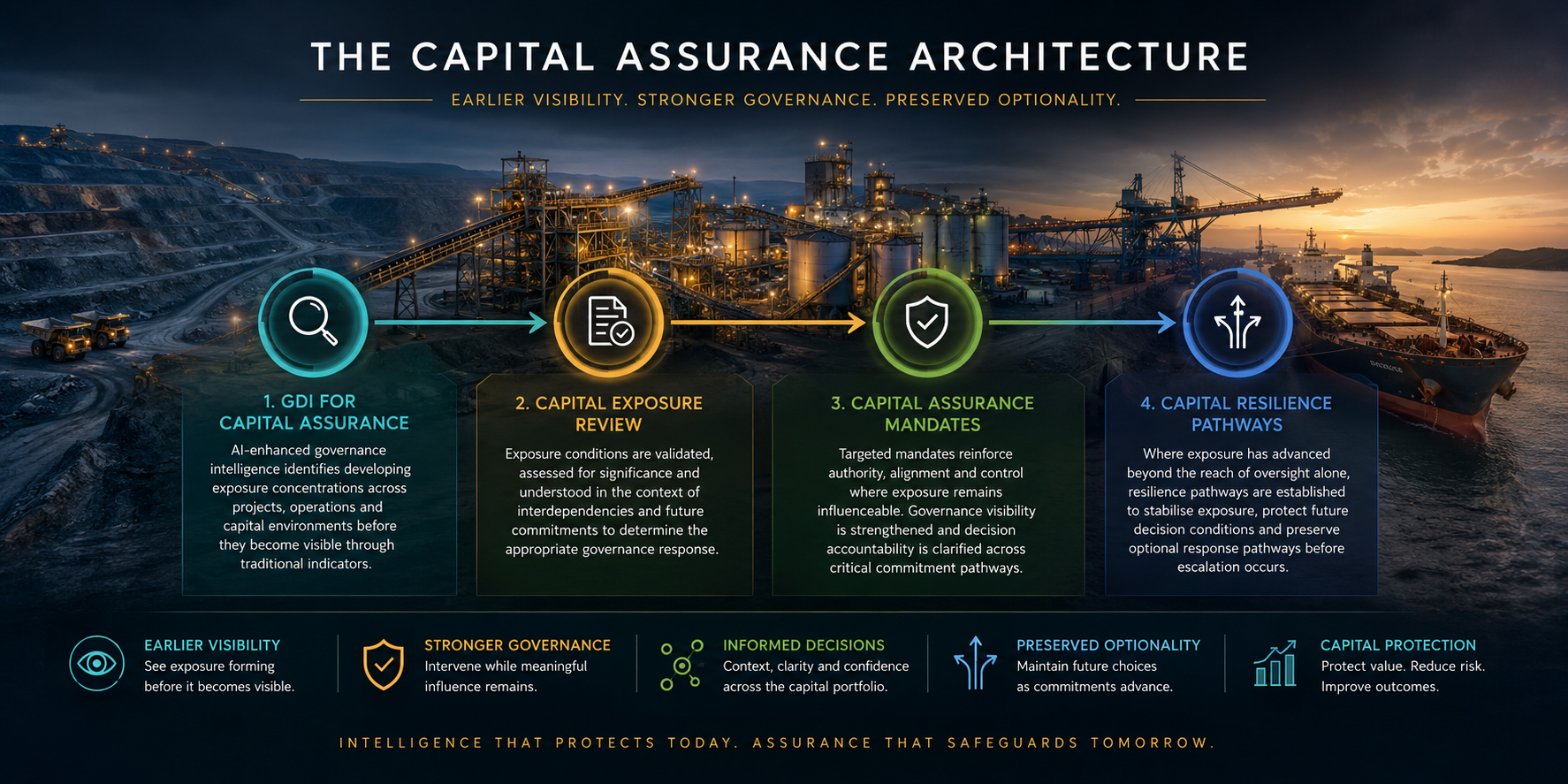
That recurring pattern led to the evolution of TacminMadini Australia’s Governance Assurance for Capital Protection model - operating earlier within the decision environment to identify exposure before capital becomes embedded in contracts, delivery structures and commercial commitments.
Early intervention remains the most effective form of capital protection.
Increasingly, organisations also require independent validation before major commitments proceed - particularly where assumptions, information and decision foundations require greater certainty before capital is further committed.
In many of these situations, projects may still appear stable and disputes have not yet formed - but leadership still requires greater factual confidence before commitments harden further.
Where this does not occur, unresolved exposure often continues moving through delivery structures, commercial relationships and stakeholder environments until operational pressure escalates and factual complexity becomes significantly harder to control.
How operational complexity becomes factual complexity
When governance failures remain unresolved, project deterioration rarely remains confined to operational performance.
Commercial relationships begin deteriorating as counterparties protect their own positions, claims escalate and historical decisions receive greater scrutiny. Leadership changes often compound these issues by weakening continuity, while legal teams, insurers and external advisers are introduced as pressure intensifies.
At this point, the issue shifts from project performance to factual clarity.
Organisations must now establish what occurred, when decisions were made and how positions evolved.
At this stage, complexity often increases rapidly. Documentation may be dispersed across multiple systems, communication records sit across multiple platforms and chronology becomes increasingly difficult to establish as competing narratives emerge.
What began as capital exposure has now become factual exposure.
Why traditional legal and forensic functions are not the issue
When matters reach this stage, organisations often engage legal counsel, forensic specialists, investigators and technical experts. These functions remain essential and play a critical role in formal disputes, claims and investigations.
The challenge is that these functions frequently enter after significant factual disorder already exists.
Legal advisers provide legal strategy. Investigators establish facts. Specialist forensic providers conduct technical review. Yet organisations are often still left managing fragmented records, inconsistent chronology and declining factual visibility while those formal processes continue.
This is not a failure of traditional providers. It reflects a structural gap that often emerges between operational breakdown and formal resolution.
Why Factual Assurance was established
Factual Assurance was established as a natural extension of TacminMadini’s governance model.
Where Governance Assurance for Capital Protection helps owners prevent exposure from becoming embedded, Factual Assurance helps organisations protect remaining value once exposure has already escalated into disputes, investigations and complex factual matters.
The objective is not to replace legal counsel, investigators or traditional forensic specialists. It is to restore structure where structure has deteriorated.
This includes restoring chronology integrity, improving documentation control, rebuilding factual visibility and helping decision-makers understand their position before further deterioration occurs. In many matters, this can materially improve how organisations engage with insurers, legal advisers, regulators and counterparties because foundational factual clarity has been restored earlier.
Not every loss can be reversed once disputes begin. However, additional losses are often amplified when factual complexity remains unmanaged.
Protecting value across both stages of exposure
Most firms operate on one side of this lifecycle. They either help organisations make better capital decisions before exposure forms or they become involved once disputes are already underway.
TacminMadini operates across both environments because the underlying governance challenge remains consistent. Whether capital is being committed without full visibility or factual positions are deteriorating too quickly, the issue remains the same: decision-makers lose visibility while exposure continues to harden.
The form of exposure changes - the governance discipline does not. In both environments, earlier visibility remains the strongest form of protection available.
To learn how TacminMadini protects value before exposure becomes harder to recover - Explore Factual Assurance