Divergence forms through uncoordinated adaptation
As fuel pressure persists, contractors adjust according to their cost structures, contractual positions and operating constraints. These adjustments are appropriate within each contract and reflect rational responses to changing conditions.
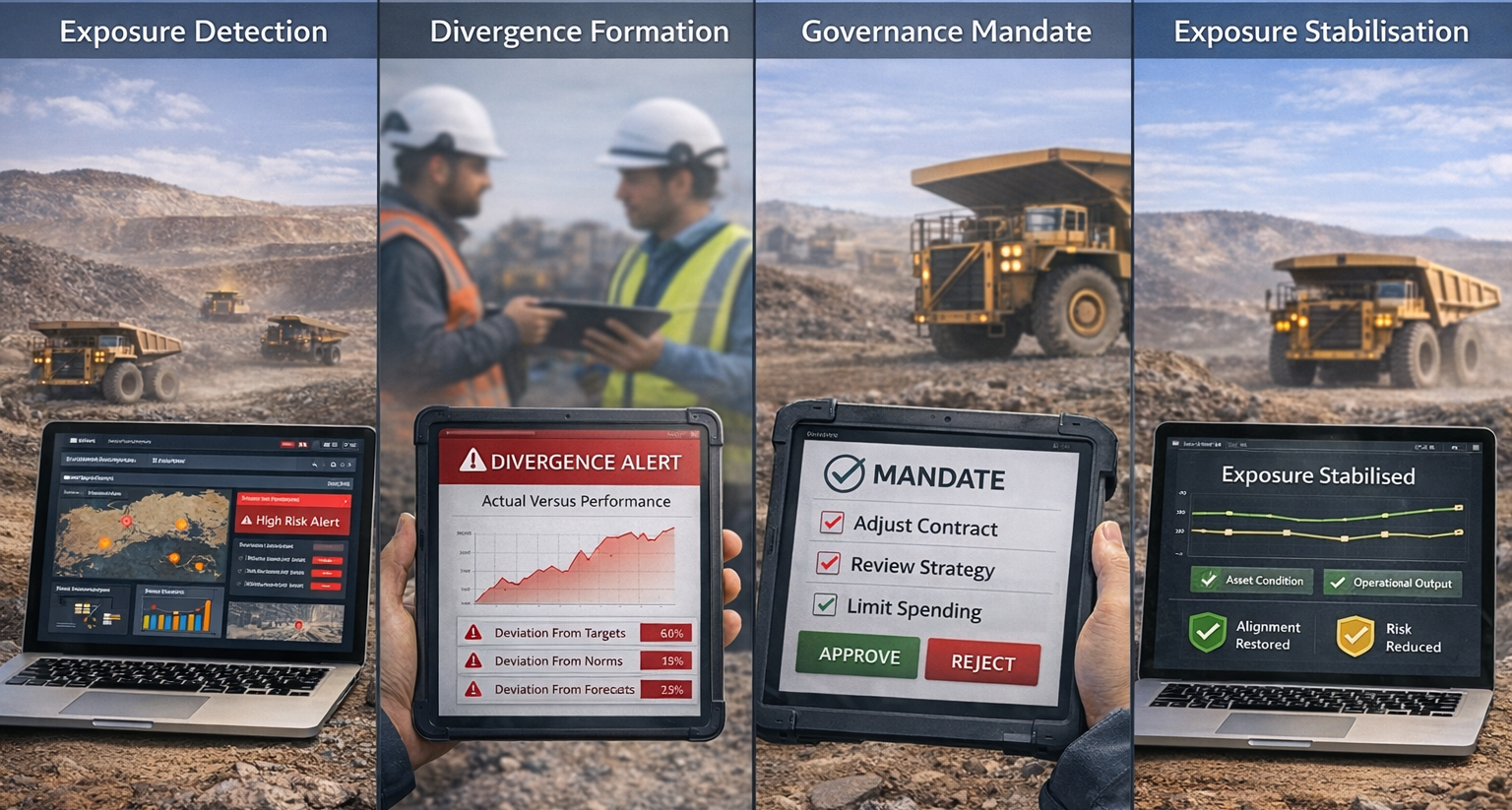
Divergence forms as these individually valid responses accumulate without a mechanism to maintain alignment across the system. Because each contractor continues to perform within its defined scope, no single element signals a breakdown.
Oversight remains focused on compliance and delivery, where performance is maintained.
The system continues to function, but not necessarily in a way that remains consistent with its governing intent. Drift begins to emerge, not as failure, but as uncoordinated adaptation across contractual boundaries.
A structural gap between accountability and visibility
At this stage, there is no formal issue. Commercial, legal and project control functions operate effectively within their respective domains, and contractual mechanisms continue to be applied as designed.
The limitation does not sit within these functions, but between them.
No single function is mandated to maintain alignment to governing intent across contractors as conditions evolve, despite accountability remaining with the owner. Visibility of how decisions are interacting at system level is therefore fragmented.
Drift does not present as disruption. It develops within continued operation, as decisions are made under progressively altered assumptions that are not reconciled across the system.
From adjustment to embedded positions
As conditions persist, responses begin to stabilise. What initially presents as flexible adjustment settles into consistent interpretation within contractual frameworks.
Each contractor establishes a position that is internally coherent and contractually defensible, but no longer necessarily aligned with the governing intent of the system as a whole. These positions are formed independently, without reference to how similar conditions are being interpreted elsewhere in the system.
At this point, divergence is no longer emerging. It is embedded.
Claims and disputes reflect loss of alignment
Once positions are established independently, alignment cannot be restored without escalation. Claims emerge as the formal expression of positions formed in the absence of maintained alignment, and disputes follow where consistency cannot be re-established.
Legal and commercial processes are then relied upon to determine outcomes in a system that no longer operates from a shared basis of intent.
Governance, at this stage, is no longer maintaining alignment. It is responding to deviation that has already become embedded, increasing the complexity and effort required to restore coherence.
An industry structured for resolution
The industry is well equipped to manage claims and disputes once they arise. Established frameworks provide structured pathways for resolution, supported by strong legal and commercial capability.
What is less developed is governance at the point where divergence is still forming.
Existing governance structures are aligned to delivery, compliance and resolution. They do not extend across the system in a way that maintains alignment as conditions evolve. Intervention therefore occurs after positions have formed, when alignment must be reconstructed rather than preserved.
Governance at the point where alignment is determined
Effective governance operates where responses are forming and where alignment can still be maintained.
At this level, governance provides visibility across contracts and operations, enabling decisions to be understood in the context of the system as a whole. Its role is not to correct outcomes after they occur, but to ensure that distributed decisions continue to reflect a coherent governing intent as conditions change.
This does not alter contractual rights or interfere with execution. It maintains consistency in how conditions are interpreted and applied across the system, preserving alignment before divergence becomes embedded.
Maintaining alignment prevents escalation
Where alignment is maintained at system level, the progression into claims and disputes changes fundamentally.
Differences are identified and reconciled while responses remain adaptable, and positions do not develop into independently defended claims.
The system continues to operate within a coherent framework, with complexity managed through alignment rather than escalation.
A closing perspective
Fuel pressure does not determine outcomes. It creates the conditions under which systems either remain aligned to their governing intent, or progressively move away from it while continuing to operate.
Where alignment is maintained as responses form, escalation does not take hold. Where it is not, claims and disputes become the mechanism through which the system attempts to reconcile outcomes that no longer share a common foundation.
Fuel pressure & commercial alignment is one of several defined governance conditions
Access Governance Policy Register