The structural limits of existing functions
Asset responsibilities are clearly delineated. Operations maintain production, maintenance manages condition, OEMs execute service, commercial teams administer contracts and finance oversees cost and capital.
Each function performs effectively within scope.
However, lifecycle alignment is not maintained within any single function. It arises across the interfaces between them, where coordination mechanisms do not maintain alignment between asset intent, execution and commercial conditions as a unified system.
This creates a structural condition in which accountability remains centralised, while control is distributed and visibility fragmented. It does not arise from failure within functions, but from the absence of governance across these interfaces.
Lifecycle exposure as a governance condition
Lifecycle exposure does not emerge as disruption. It develops progressively within systems that continue to perform.
It becomes evident through outcomes. Asset value deviates, cost assumptions shift and performance consistency erodes as conditions are applied differently across the system.
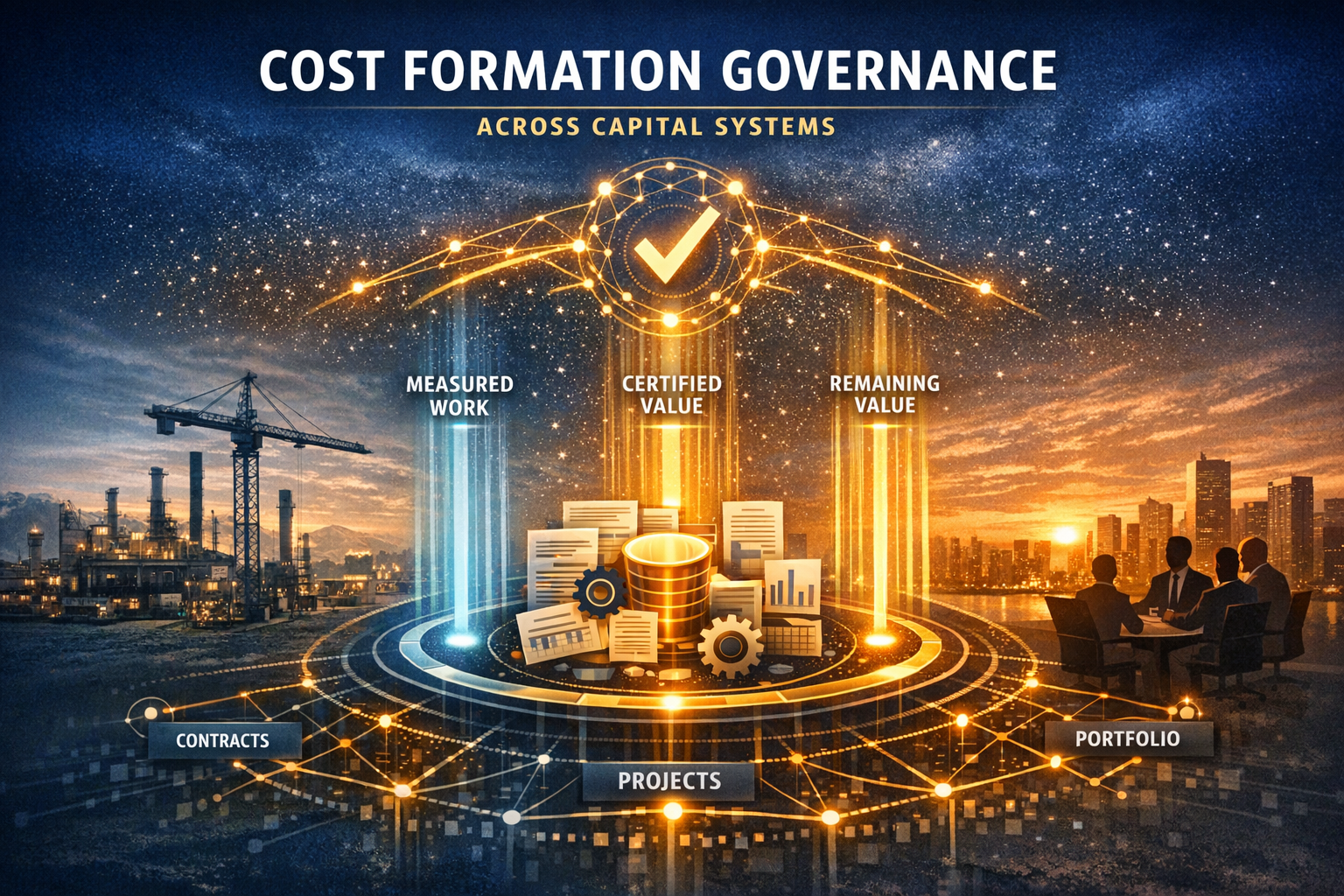
Under pressure, lifecycle cost is not simply incurred - it is formed across the system.
The absence of disruption should not be interpreted as evidence of lifecycle control. By the time exposure is visible, it is already embedded.
Why lifecycle alignment sits outside formal governance
Conventional governance frameworks provide assurance across financial performance, risk, compliance and reporting.
These structures are effective within their domains.
However, they do not govern how lifecycle outcomes are formed across distributed execution environments in real time.
Lifecycle alignment exists at the intersection of technical, operational and commercial domains. It is not captured within any single governance function and is often assumed rather than governed.
This represents a gap in governance, not in capability.
Lifecycle alignment as a defined governance requirement
Lifecycle alignment must be established as a formal governance condition.
This requires governance to operate at the point where lifecycle outcomes are created, across the interaction between asset strategy, OEM execution and commercial arrangements, under explicit owner authority.
At this level, governance maintains alignment between intent, obligation and execution as conditions evolve. It provides visibility of emerging divergence and the authority to maintain alignment before misalignment becomes embedded.
Governance shifts from observing outcomes to intervening at the point of formation, while remaining independent of execution.
A governance blueprint for lifecycle alignment
A governance blueprint establishes how control is exercised where lifecycle outcomes are formed.
It provides visibility across the interaction between asset strategy, OEM execution and commercial frameworks, enabling divergence to be identified as it emerges. It defines how authority is applied across these interfaces to maintain alignment in real time.
This requires a governance function that operates across organisational, contractual and operational boundaries, without being part of the execution environment it governs.
In doing so, it reduces inconsistency, limits rework and preserves lifecycle value, cost and performance outcomes while stabilising conditions across service providers.
Governance anticipates and stabilises conditions as they develop, rather than responding once outcomes have been realised.
From application to governance standard
When applied consistently, lifecycle governance becomes defined and repeatable.
The conditions under which alignment is maintained, the decision pathways through which it is governed and the interventions required to preserve it become structured.
This enables the governance blueprint to be formalised as an owner policy, transferring the capability to maintain lifecycle alignment from intervention to the organisation itself under owner authority.
Restoring alignment between accountability and control
Where lifecycle alignment is governed at system level, the relationship between accountability and control is re-established.
Boards and executives gain visibility of how asset value and lifecycle cost are being formed, not only how they are reported. Control over cost and performance trajectories is strengthened, and alignment is maintained across distributed execution.
Cost is governed at the point where it is created, rather than managed retrospectively through variance and explanation.
Governance shifts from retrospective assurance to active control.
A closing perspective
Asset systems are capable of sustained operational performance while lifecycle exposure develops within them.
The absence of disruption should not be interpreted as the presence of alignment.
Where lifecycle alignment is not governed, exposure forms progressively and becomes visible only once embedded. Where it is established as a defined governance condition, asset value is preserved, cost remains controlled and outcomes stay aligned with intent.
External cost pressures do not create lifecycle issues - they expose how lifecycle outcomes are being formed across the system.
Lifecycle Performance Alignment is one of several defined governance conditions
Access Governance Policy Register