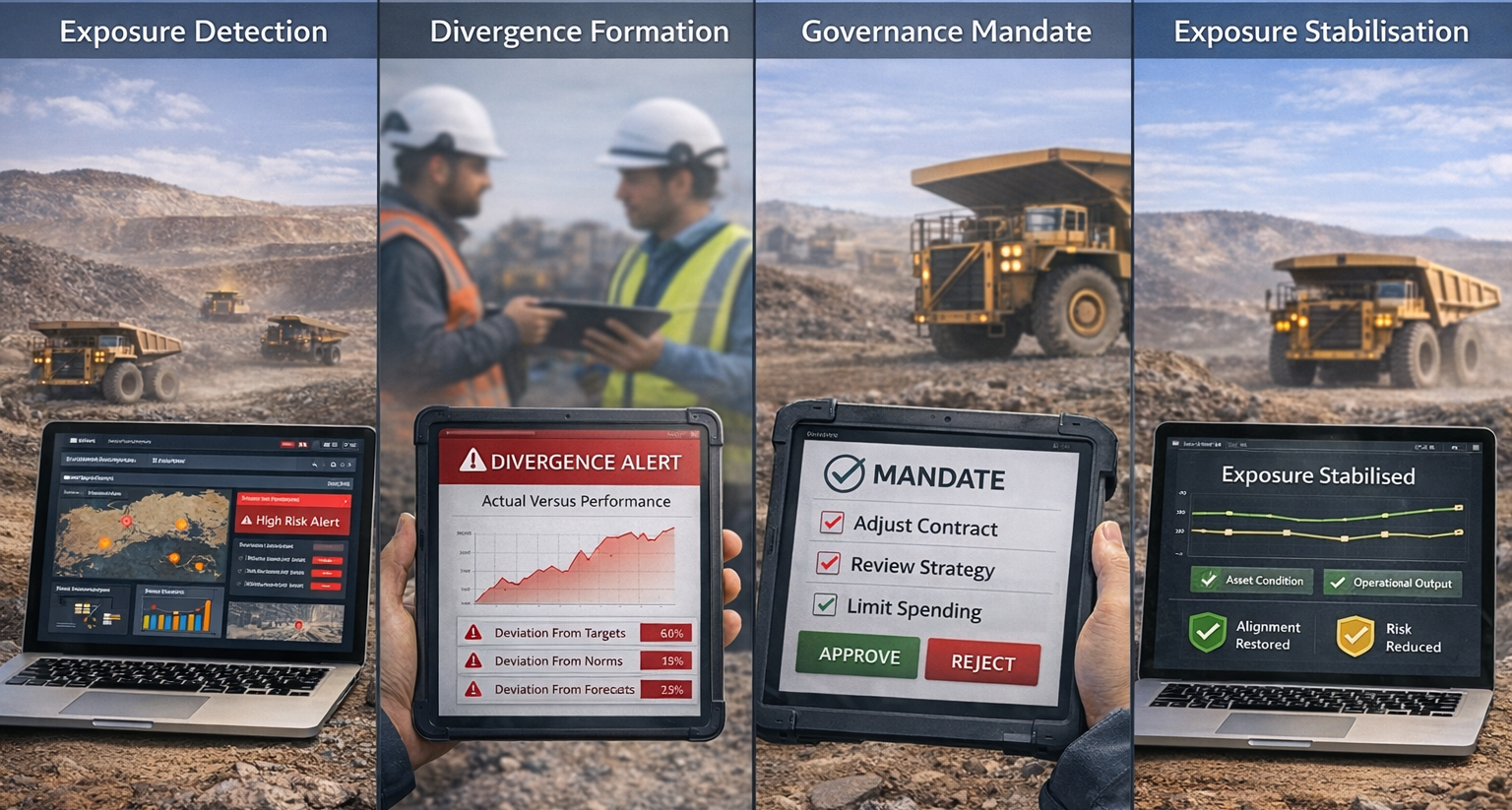
Where the First Misalignment Appears
Early visibility across the transition highlighted that the sequence was beginning to drift under pressure.
Shipment booking had progressed ahead of full factory acceptance, with outstanding technical clarifications still unresolved. At the same time, site readiness remained incomplete, with civil works behind schedule and power infrastructure not yet energised. These conditions were being managed separately, but together they created a clear sequencing conflict.
If left unaddressed, the unit would have been shipped and arrived at a site unable to receive it, resulting in idle time, double handling and potential damage exposure. Governance intervened at this point, directing that the shipment be held and re-sequenced against verified readiness conditions, reducing the risk of a misaligned start to the transition.
Pressure Builds Across the Supply Chain
As the shipment was re-sequenced and the unit moved into transit, pressure shifted into logistics. Early review identified that customs documentation was incomplete, transport availability was constrained, and site access conditions were not fully aligned with delivery timing.
Individually, these were manageable issues. Together, they created a high likelihood of delay at clearance and congestion on arrival. Early indicators of this began to show, with documentation revisions required late and transport windows tightening.
Governance Assurance Mandates were established to coordinate these interfaces under a single sequence, forcing alignment between shipping arrival, clearance readiness, transport booking and site access. This reduced the risk of the unit stalling between stages and avoided compounding delays that would have disrupted installation.
Installation Under Real Constraints
On arrival, the unit entered a live operating environment already under pressure. Installation teams mobilised quickly, but as work progressed, sequencing conflicts began to emerge. Mechanical installation activities started to overlap with incomplete electrical preparation, and contractor access to critical areas became constrained.
At the same time, there was increasing pressure from operations to accelerate installation and bring the new crushing and screening unit online to relieve production constraints. Early signs of rework began to appear where activities were attempted out of sequence.
As these conflicts became visible, governance intervened to direct installation sequencing under controlled conditions. Activities were re-ordered to respect dependencies, and access was coordinated to prevent further overlap. This slowed visible progress in the short term, but avoided compounding rework and disruption to the existing plant.
The Point Where Systems Begin to Slip
Commissioning introduced the highest level of pressure. Initial runs of the new unit showed throughput variability, operating at approximately 60 - 70% of expected capacity, with inconsistent output affecting downstream stockpiling.
This began to create visible operational strain. Certain product sizes accumulated unevenly, dispatch sequencing became less predictable, and early signs of backlog began to emerge across delivery schedules.
At the same time, commercial pressure intensified. Planning functions began preparing to allocate work to the new unit based on expected capacity, driven by customer demand and the need to relieve the existing system.
This was the point where the system was closest to slipping.
Governance Decision Intelligence identified that production commitment was about to outpace stable output. Governance Assurance Mandates were enforced to prevent premature reliance, separating commissioning from full production allocation and ensuring that capacity was only released once consistent performance thresholds were achieved.
While these controls limited escalation, they did not eliminate the immediate operational strain created by early variability.
Stabilising a System Under Load
Despite these controls, the system had already begun to feel the effects of early variability. Stockpile imbalance required rehandling, dispatch windows tightened, and a short-term backlog began to form.
At this point, oversight alone was no longer sufficient.
Governance Resilience Pathways were enacted to stabilise the system under defined authority. This directed a controlled reset of how the system was operating, maintaining the existing crushing and screening unit as a stable base while tightly governing the ramp-up of the new unit.
Decision-making across production, planning and logistics was consolidated, removing conflicting instructions and restoring alignment. The system did not return to stability immediately, but the drift was arrested before it escalated further.
Reintroducing Demand Without Recreating the Problem
As performance from the new unit began to stabilise, pressure returned from the market. Sales and planning functions moved to reintroduce volume, with a clear push to recover lost ground and utilise the new capacity.
Governance Decision Intelligence identified that this reintroduction risked repeating the same conditions that had just been stabilised, with demand once again moving ahead of demonstrated capability.
Governance directed that demand be reintroduced progressively, aligned to proven output rather than expected performance. This ensured that throughput increased in step with stability, rather than reintroducing volatility into the system.
From Pressure to Performance
As the system stabilised, utilisation of the new crushing and screening unit increased toward sustained levels of 80 - 90%. Stockpile balance improved, dispatch stabilised, and turnaround times improved by approximately 20 - 25%.
Overall throughput increased by approximately 30 - 40% relative to the original baseline, not simply as a result of adding capacity, but because that capacity was introduced, stabilised and aligned with demand under controlled conditions.
Revenue followed from that alignment, supported by consistent output and predictable delivery performance.
Final Perspective
What this case demonstrates is that capacity does not fail at installation. It begins to fail much earlier, in the sequencing decisions, interface misalignments and pressures that build across the system before the asset is even operational.
The risk is rarely a single event. It is a series of misalignments that compound under pressure until the system loses control. In practice, these conditions are rarely unidentified. More often, they are visible but accepted under pressure, with decisions made in anticipation that the system will absorb the impact.
What changes the outcome is the ability to detect those misalignments early, govern how decisions are made at each stage, and intervene before instability becomes a consequence.
TacminMadini’s governance architecture provides independent authority to detect, challenge and stabilise decisions across complex asset systems where internal pressures would otherwise drive misalignment.
“Detect early. Assure decisions. Stabilise outcomes.”